Introduction
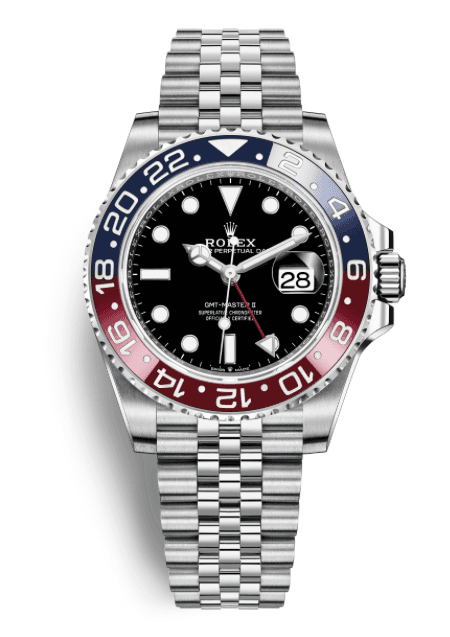
The red and blue bezel has been a Rolex signature since the mid-1950s. It appeared on the very first GMT-Masters built for Pan American Airways pilots, a colour scheme chosen for functional legibility — red for day hours, blue for night — that happened also to produce one of the most immediately recognisable watch bezels ever manufactured. For three decades, the Pepsi bezel was available in steel. Then, in the late 1980s, Rolex moved it to gold only, and the steel Pepsi disappeared from the catalogue for the better part of thirty years.
It came back at Baselworld 2018 on the reference 126710BLRO, paired with the new Calibre 3285 and — initially — the Jubilee bracelet exclusively. The response was immediate and sustained.
The 126710BLRO has been confirmed absent from Rolex's 2026 catalogue at Watches & Wonders 2026, making it the subject of active discontinuation discussion. This guide covers everything buyers need to know: full specification, both bracelet variants, the complete history of the Pepsi bezel, the Calibre 3285, and the market context.
Quick Specifications
- Brand: Rolex
- Model: GMT-Master II
- Reference: 126710BLRO
- Sub-references: 126710BLRO-0001 (Jubilee bracelet, launch 2018); 126710BLRO-0002 (Oyster bracelet, added 2021)
- Case Material: Oystersteel (904L)
- Case Size: 40mm × 12mm
- Dial: Black; applied luminous hour markers; Chromalight inserts (blue emission); date at 3 o'clock with Cyclops lens; independently settable 24-hour arrow-tipped red GMT hand
- Bezel: Bidirectional rotatable; two-colour red/blue Cerachrom ceramic insert; 24-hour graduated scale; platinum-filled numerals and graduations via PVD
- Crystal: Scratch-resistant sapphire with anti-reflective coating; Cyclops lens over date
- Bracelet (0001): Jubilee, five-piece solid links, polished centre and satin outer links; concealed Oysterclasp with safety catch; 5mm Easylink extension
- Bracelet (0002): Oyster, three-piece solid links, polished centre / brushed outer; Oysterlock folding safety clasp; 5mm Easylink extension
- Movement / Caliber: Rolex Calibre 3285, in-house
- Frequency: 4Hz (28,800 vph)
- Power Reserve: Approximately 70 hours
- Complications: GMT / second time zone via independent rapid-setting hour hand; date with instantaneous display; stop-seconds
- Certification: Superlative Chronometer (±2 sec/day)
- Water Resistance: 100m / 330ft; Triplock screw-down crown
- Production Period: Introduced Baselworld 2018; Oyster variant added 2021; absent from 2026 Rolex catalogue
History of the Model and the Pepsi Bezel
The GMT-Master was developed in direct collaboration with Pan American Airways in 1955. The reference 6542 — the first GMT-Master — used the original red and blue aluminium bezel insert. The GMT-Master II designation arrived with the 16760 in 1983, introducing the independently settable hour hand that distinguishes the GMT-Master II from the original.
The Pepsi bezel moved to gold-only in the late 1980s. The steel Pepsi disappeared until the 126710BLRO's debut at Baselworld 2018 — ending a thirty-plus year absence. The Jubilee bracelet on the original launch connected the 126710BLRO explicitly to the heritage of the 1960s and 1970s GMT-Masters. The Oyster bracelet variant (126710BLRO-0002) arrived in 2021.
Movement and Technical Details
The Calibre 3285 incorporates the Chronergy escapement, Parachrom hairspring, Paraflex shock absorbers, and a 70-hour power reserve — up substantially from the Calibre 3186's approximately 48 hours in the previous generation. The GMT function allows the hour hand to be advanced or reversed in one-hour increments without stopping the running seconds — operated by pulling the crown to the first position and rotating. Certified to Superlative Chronometer standard of ±2 sec/day.
The Discontinuation Question
The 126710BLRO was absent from Rolex's announced 2026 catalogue at Watches & Wonders 2026. Rolex has not made a formal discontinuation statement — the brand rarely does. Publicly available listing data shows the 126710BLRO has repriced since the 2026 catalogue absence became clear, with premiums moving upward. For buyers, the practical implications are: retail allocation is now likely zero for new examples, the secondary market is the only route to acquisition, and full-set condition commands a heightened premium.
Jubilee vs Oyster
126710BLRO-0001 — Jubilee bracelet. The launch configuration (2018). Period-correct pairing for the Pepsi reference, connecting to the GMT-Masters of the 1960s and 1970s. Commands a modest premium over the Oyster variant on most secondary markets.
126710BLRO-0002 — Oyster bracelet. Added to the range in 2021. Sportier and more linear in character. Trades at a slight discount to the Jubilee in most secondary market contexts, though the gap is not dramatic.
Buying Advice
Jubilee or Oyster. Decide before you start looking — the right answer is personal. Assess bracelet condition carefully. The Jubilee bracelet's curved links can develop stretch and rattle with wear. Full set — non-negotiable. Box, papers, GMT guarantee card, all accessories. Serial number and papers consistency. Confirm the warranty card serial matches the case. Timing. Given the 2026 catalogue absence, secondary market pricing is in active formation. Buyers who have clear reasons for wanting this reference specifically should not assume current pricing represents either the ceiling or the floor.
Final Thoughts
The Rolex GMT-Master II 126710BLRO is the watch that definitively answered three decades of collector questions about whether the steel Pepsi would return. The Calibre 3285 is excellent, the Cerachrom Pepsi bezel is beautiful, and the functional GMT implementation is the best available in a series production watch. The 2026 catalogue absence adds a dimension of urgency to a reference that was already compelling. Wind It Up Watches can help source a verified example through our trusted network.