Introduction
There are watches you admire, and then there are watches people actually queue for. The Rolex Cosmograph Daytona 126500LN in white "Panda" dial sits firmly in the second category — and has done so since the moment it was announced at Watches & Wonders Geneva in April 2023.
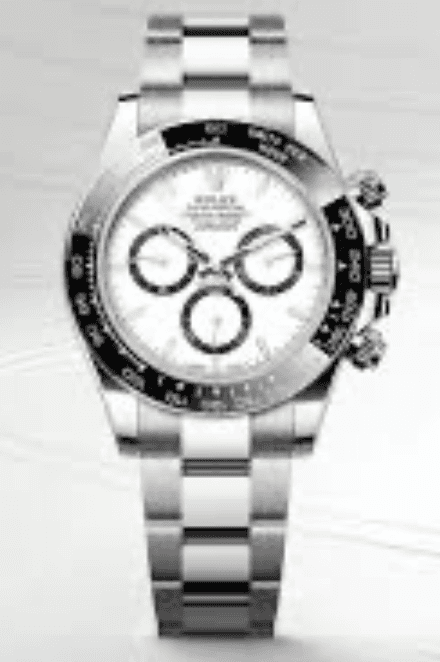
The Panda configuration, with its white lacquered dial and contrasting black subdials, is perhaps the single most iconic layout in the Daytona's sixty-year history. It reads immediately, it photographs beautifully, and it carries the kind of cultural weight that very few references ever accumulate. The 126500LN is the latest expression of that layout — and while Rolex has positioned it as an evolution of the outgoing 116500LN, the changes run deeper than a casual glance suggests.
This guide covers everything: the full specification, the model's history, what's changed in this generation, how the 126500LN sits in the secondary market today, and what to look for when buying one.
Quick Specifications
- Brand: Rolex
- Model: Cosmograph Daytona
- Reference: 126500LN (sub-reference 126500LN-0001 for white/Panda dial)
- Case Material: Oystersteel (904L)
- Case Size: 40mm × 11.90mm
- Dial: White lacquered, black counter rings on subdials, red "Daytona" text, 18k white gold applied hour markers with Chromalight
- Bezel: Monobloc Cerachrom black ceramic with tachymetric scale; platinum-filled graduations and numerals via PVD; polished Oystersteel edge
- Bracelet: Oyster, three-piece solid links in Oystersteel; Oysterlock folding safety clasp with 5mm Easylink comfort extension
- Movement / Caliber: Rolex Calibre 4131, in-house manufacture
- Frequency: 4Hz (28,800 vph)
- Power Reserve: Approximately 72 hours
- Complications: Chronograph (centre seconds, 30-minute counter at 3 o'clock, 12-hour counter at 9 o'clock); stop-seconds for precise time setting
- Certification: Superlative Chronometer — COSC certified, then re-certified by Rolex post-casing to ±2 seconds/day
- Water Resistance: 100m / 330ft (Triplock screw-down crown and pushers)
- Crystal: Scratch-resistant sapphire with anti-reflective coating
- Production Period: Introduced April 2023; current production
- Current Status: In production; available through authorised dealers (with significant waitlists) and the secondary market
What Is the 126500LN?
The 126500LN is Rolex's current-generation steel Cosmograph Daytona — the entry point into the Daytona range if "entry point" is a term you can apply to a watch trading well above its retail price. It replaced the 116500LN in 2023, after that reference had a production run of approximately seven years.
The "LN" suffix in the reference number denotes the black ceramic (Lunette Noire) bezel — the defining visual detail of the modern steel Daytona since the ceramic bezel was introduced with the 116500LN in 2016. The 126500LN-0001 sub-reference specifies the white "Panda" dial, as distinct from the 126500LN-0002, which carries the black "Reverse Panda" configuration.
For someone encountering the Daytona for the first time: this is a 40mm steel chronograph with a column-wheel movement, a tachymeter scale on the bezel for calculating average speed, and a tricompax subdial layout that dates back to the very first Daytonas of 1963. It is simultaneously a serious tool watch and one of the most recognisable status symbols in watchmaking.
History of the Model
The Cosmograph Daytona has been in continuous production since 1963, making it one of the longest-running chronograph lines from any manufacturer. Understanding the 126500LN means understanding the four distinct eras that preceded it.
The original Daytonas — references 6239, 6241, 6262, and others — were hand-wound, relied on external tachymeter scales or acrylic bezels, and are now among the most fiercely contested watches at auction. The market for early Daytonas, particularly those with exotic "Paul Newman" dials, operates in a completely different universe from the modern market.
In 1988, Rolex made a controversial decision: unable to produce a sufficiently reliable in-house automatic chronograph movement, they turned to Zenith and adopted a modified version of the El Primero calibre. The resulting references — 16520 and its variants — are now beloved by collectors who appreciate the higher-beat movement and the era's more complex case finishing.
The in-house era began in 2000 with the reference 116520, powered by the entirely new Calibre 4130. The 4130 is considered by many movement specialists to be one of the most robust and elegant chronograph ebauches ever produced — a column-wheel, vertical clutch design with just 291 components. This generation ran until 2016, when the ceramic bezel 116500LN replaced it.
The 116500LN became the definitive modern Daytona. It ran from 2016 until April 2023, when the 126500LN was unveiled to mark the model's 60th anniversary. The new generation brought the upgraded Calibre 4131, a revised case, a subtly redesigned dial, and the addition of a polished metal edge to the ceramic bezel.
Design Details
At 40mm, the 126500LN sits at a size that works across a wide range of wrist sizes without feeling either oversized or anachronistic. The case height of 11.90mm keeps it from feeling bulky under a shirt cuff, which is not something you can say about every modern chronograph.
The case itself is entirely polished — no brushed surfaces — giving the Daytona a more dressy feel than the Submariner or GMT-Master II. The integrated crown guards are angular and squared-off, and the lugs on the 126500LN have been subtly revised versus the 116500LN, angling slightly downward to improve the watch's conformity to the wrist.
The bezel is the defining visual element. The monobloc Cerachrom ceramic construction means the tachymeter scale is part of the bezel material itself, filled with platinum via PVD — it cannot scratch or fade. The addition of a polished Oystersteel edge around the ceramic is new to this generation and one of the clearest visual tells distinguishing the 126500LN from the 116500LN.
The Panda dial is a study in contrast management. The lacquered white base provides a brilliant, light-reflective surface. The three subdials — running seconds at 6 o'clock, 30-minute counter at 3 o'clock, and 12-hour counter at 9 o'clock — are framed by black rings that have been made slightly thinner in this generation. The applied 18k white gold hour markers have Chromalight inserts. The red "Daytona" text at 6 o'clock is a detail that dates back decades and adds warmth that breaks the monochrome palette without overpowering it.
Movement and Technical Details
The Calibre 4131 is the headline technical update of the 126500LN generation — an evolution of the outgoing 4130, which was itself widely regarded as one of the finest chronograph ebauches in series production.
The key addition is Rolex's patented Chronergy escapement, manufactured from nickel-phosphorus. This material offers meaningful resistance to magnetic fields and, in combination with the redesigned geometry, improves energy efficiency across the full power reserve. The oscillator uses a blue Parachrom hairspring — a paramagnetic alloy developed by Rolex — mounted on Paraflex shock absorbers.
The architecture retained from the 4130 includes the column-wheel and vertical clutch chronograph mechanism. The vertical clutch engages the chronograph seconds hand without a visible jump or jolt, and the column wheel provides more consistent operation over time compared to a cam-and-lever design.
Power reserve is approximately 72 hours. Certification is dual: first by COSC to the standard Chronometer level (±4 seconds per day), then by Rolex post-casing to their Superlative Chronometer standard of ±2 seconds per day.
Variations of the Model
Within the 126500LN reference, there are two dial configurations:
126500LN-0001 — White "Panda" dial. The subject of this article. White lacquered base, black subdial rings. The high-contrast configuration that has dominated the modern Daytona's image.
126500LN-0002 — Black "Reverse Panda" dial. Black dial with silver-toned subdial rings. More subdued in character, arguably more versatile with formal dress. Secondary market demand is strong, though slightly behind the Panda in terms of raw premium.
Beyond the 126500LN, the broader 2023 Daytona range includes two-tone Rolesor (126503), yellow gold on Oysterflex (126518LN), Everose gold on Oysterflex (126505), and the platinum reference (126506) with its ice blue dial, chestnut ceramic bezel, and a sapphire caseback revealing the calibre 4131.
Why Collectors Care
The steel Daytona Panda has occupied a specific position in the collector market for years: it is one of the few watches that is simultaneously genuinely desirable for horological reasons and structurally difficult to acquire at retail. On the horological side, the calibre is exceptional. The design has decades of racing heritage. The ceramic bezel resolved the one long-standing durability criticism of the aluminium-bezel era. And the Panda layout is arguably the most legible chronograph dial configuration that exists.
On the scarcity side: authorised dealers routinely maintain long waitlists. New customers without an established purchase history with a boutique face a particularly challenging path to retail allocation. This structural supply restriction is not artificial — Rolex produces what it produces — but it creates persistent secondary market demand.
How It Compares
Patek Philippe Aquanaut Chronograph 5968A. At roughly double the price of a secondary market Daytona, the 5968A offers Patek's ultra-thin CHR 29-535 PS movement and the institutional weight of the Patek name. The Daytona is the stronger watch in terms of legibility and sporting character; the Patek has broader dress versatility.
Audemars Piguet Royal Oak Chronograph 26240ST. The AP offers an integrated bracelet, a more distinctive design identity, and in-house calibre 4409. The Royal Oak Chronograph is more architecturally dramatic; the Daytona is more classically resolved.
Tudor Black Bay Chrono. At a fraction of the secondary market price, the Black Bay Chrono offers excellent build quality and a compelling heritage story. It is not a direct competitor in terms of collector demand dynamics or market liquidity.
Market and Price Context
The 126500LN launched in 2023 at a Rolex-published retail price of approximately EUR 14,950 in Europe and around USD 16,100 in the United States. Secondary market prices since launch have sat comfortably above retail — publicly available listings and market tracking platforms indicate premiums that have moderated from post-announcement highs but remain substantial.
Supply restriction. Authorised dealer allocation of the steel Daytona is limited, and demand substantially exceeds available supply. Condition sensitivity. Full-set examples (box, papers, chronograph guarantee) command meaningful premiums over watch-only. Dial variant. The Panda (0001) typically attracts a slight premium over the Reverse Panda (0002), though both trade well. Case condition. An unpolished case carries a meaningful premium with informed buyers.
Buying Advice
If you are sourcing a 126500LN on the secondary market, these are the things that matter:
Complete set. Box, papers (Rolex international warranty card), hang tags, and booklets. The warranty card serial number should match the case. Unpolished case. Ask specifically whether the case has been polished. Service history. The 126500LN is a young reference, so major service is unlikely to be necessary. However, understanding whether the watch has been opened or worked on is relevant. Dial and hands. The Panda dial should be crisp and even, with no discolouration around the subdial rings. Trusted sourcing. The Daytona's profile means it attracts fakes and franken-watches. Source from dealers who can demonstrate authentication.
Final Thoughts
The Rolex Cosmograph Daytona 126500LN in Panda configuration is one of the most fully resolved watches in current production. The case is refined, the movement is excellent, the design has sixty years of development behind it, and the secondary market demand is structural rather than speculative. Wind It Up Watches can help source a verified example through our trusted network.